Important News

International Day for Judicial Well-being: A Global Call for Action (4 Mar, 2025)

Pakistan Ranks 129 out of 142 in the World Justice Project Rule of Law Index (26 Oct, 2024)

2024 Trafficking in Persons Report: Pakistan (24 June, 2024)

Pakistan ranks second-last in WEF Global Gender Gap Report 2024 (7 Mar, 2025)
Pakistan concludes UN Anti-Torture review, highlights reforms
Sun, April 26, 2026
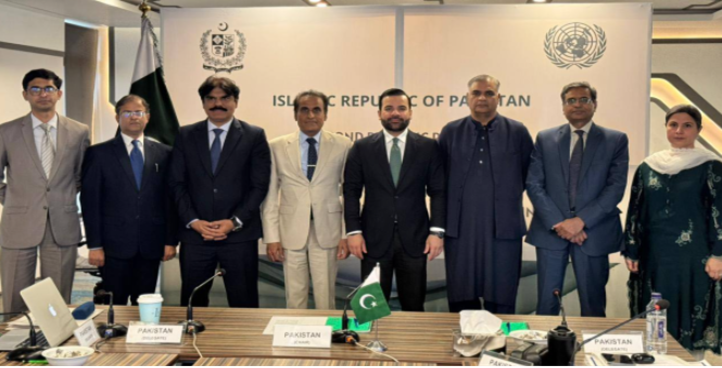
Pakistan concluded its second periodic review before the United Nations Committee Against Torture, reaffirming its commitment to eliminating torture and strengthening protections under international human rights law at the 84th Session of the UN Committee Against Torture (CAT).
The Committee against Torture commending the adoption of the 2022 torture and custodial death act and raising questions about the reported use of torture by the police and the 2023 illegal foreigners’ repatriation plan and its impact on Afghan nationals.
Naoko Maeda, Country Co-Rapporteur and Committee Expert, welcomed the adoption of the torture and custodial death act, which she said represented an important step towards strengthening the legal framework to prevent custodial abuse and criminalise torture and custodial death.
Peter Vedel Kessing, Country Co-Rapporteur and Committee Expert, expressed grave concern over consistent reports that the use of torture by the police was widespread throughout Pakistan. The types of torture reported included beatings with batons, sexual violence, prolonged sleep deprivation, and mental torture. Had officials at the highest level made a statement condemning torture?
Ms. Maeda said that in September 2023, Pakistan initiated the illegal foreigners’ repatriation plan, mainly targeting Afghans present in the country. In this context, threats of deportation, police abuse, and extortion were reported. What measures had been taken to mitigate the negative impact of the plan? How did the State party ensure, without coercion, persons’ willingness to be voluntarily returned?
Introducing the report, Aqeel Malik, Minister of State for Law and Justice of Pakistan and head of the delegation, said Pakistan had embarked upon a structured and forward-looking reform process, a milestone of which was the enactment of the torture and custodial death (prevention and punishment) act 2022. This legislation provided a comprehensive statutory definition of torture and criminalised custodial abuse, coercion, intimidation and ill-treatment committed by public officials.
Pakistan had a zero-tolerance policy regarding torture, the delegation said. The Government had aligned training programmes for officials directly responsible for detentions, interrogations and investigations with the Mendez Principles. Senior officers were held responsible for torture under the Penal Code if they engaged in such acts, shielded subordinates involved in torture, or were involved through negligence, abatement or omission. Several officers had been punished departmentally.
The illegal foreigners’ repatriation plan was conducted in a humane manner, the delegation said, with many countries agreeing to resettle refugees. Documentation checks, identity validation, and administrative reviews were carried out before decisions were executed. Persons subjected to proceedings could lodge complaints to a 24/7 complaints cell. During the implementation period, more than 427,000 visas were issued to Afghan nationals on medical grounds. Pakistan had also issued thousands of scholarships to Afghan students to support them to study legally in the country.
In closing remarks, Claude Heller, Committee Chair, said that the dialogue had been constructive and substantive. Based on the dialogue, the Committee would adopt concluding observations on 1 May, which would include three recommendations that could be implemented within one year.
In his concluding remarks, Mr. Malik said that the State party had implemented significant steps to eradicate torture completely from society, guided by the Committee’s recommendations. However, effective implementation of the Convention required continued efforts. The Committee’s forthcoming concluding observations would serve as a roadmap for the next phase of the State party’s reform process.
PJN Facebook
Digital Defenders Pakistan
National Legal Incubation Center

PJN SDG 16 Knowledge HUB
PJN Naya Daur Media

Free Legal Help 0800-46723
Copyright © 2026 pjn.org.pk