
International Day for Judicial Well-being: A Global Call for Action (4 Mar, 2025)

Pakistan Ranks 129 out of 142 in the World Justice Project Rule of Law Index (26 Oct, 2024)

2024 Trafficking in Persons Report: Pakistan (24 June, 2024)

Pakistan ranks second-last in WEF Global Gender Gap Report 2024 (7 Mar, 2025)
Future of Pakistan’s justice system lies in ADR, Justice (R) Mansoor Ali Shah
Wed, April 08, 2026
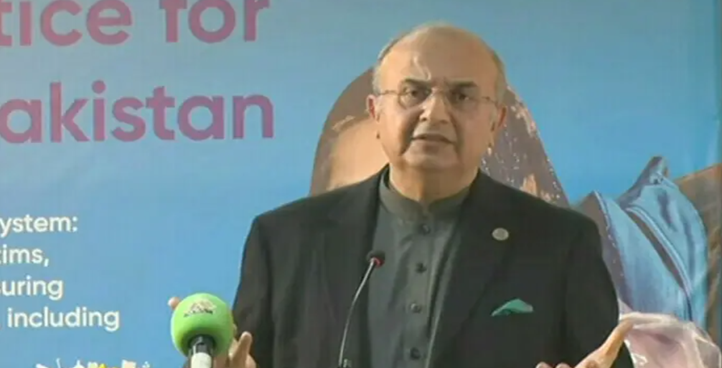
Supreme Court’s former senior puisne judge Syed Mansoor Ali Shah on Saturday said the future of Pakistan’s justice system lies in Alternate Dispute Resolution (ADR), urging lawyers to understand and adapt to their evolving role in this framework.
Addressing the second national conference on ADR, retired justice Shah noted that, unfortunately, arbitration remains difficult in Pakistan due to existing legal constraints.
He said that ADR does not undermine the judicial system, rather, disputes can be resolved more naturally through dialogue and negotiation.
“The biggest flaw in our justice system is delay.”
He stated that by the time a case reaches the Supreme Court and a convict is acquitted, as many as 17 years may have passed.
He questioned why no one asks why the conviction was handed down in the first place.
“Who would account for the suffering endured by the convict and his/her family during those 17 years. This question has no answer,” he remarked.
Citing international practices, he referred to China’s approach, saying Chinese stakeholders prefer avoiding litigation as court cases often damage relationships, therefore, they opt for reconciliation instead.
He added that under China’s founding leader Mao Zedong, millions of disputes were resolved through committees.
Justice Shah observed that legal education in Pakistan is largely based on adversarial approach rather than reconciliation-oriented.
He highlighted that in China, mediation is mandatory, while Islam also prioritises resolving disputes through compromise. He noted that the Prophet Muhammad (PBHU) resolved many conflicts through reconciliation.
He stressed that any mediation framework must ensure satisfaction of both parties and that a mediator must be a good listener.
He pointed out that countries such as Turkey, the United States, Italy and India had made mediation mandatory before going for traditional litigation.
Expressing concern, Justice Shah said that although laws related to ADR exist in Pakistan, their implementation remains weak.
The country must eventually move towards a culture of reconciliation, he added.
After the event, Justice Shah had an informal conversation with the reporters.
Asked about the effect of the 26th and 27th constitutional amendments on the life of a common man, he said the amendments drastically changed the structure of the justice system. He said the role in the appointment of judges had been shifted to the executive.
He also questioned the establishment of the Federal Constitutional Court, what he claimed, without a clear parameter for the appointment of its judges.
“The greatest strength of a court lies in public trust. Without it, a court becomes ineffective,” he asserted.




Copyright © 2026 pjn.org.pk