
International Day for Judicial Well-being: A Global Call for Action (4 Mar, 2025)

Pakistan Ranks 129 out of 142 in the World Justice Project Rule of Law Index (26 Oct, 2024)

2024 Trafficking in Persons Report: Pakistan (24 June, 2024)

Pakistan ranks second-last in WEF Global Gender Gap Report 2024 (7 Mar, 2025)
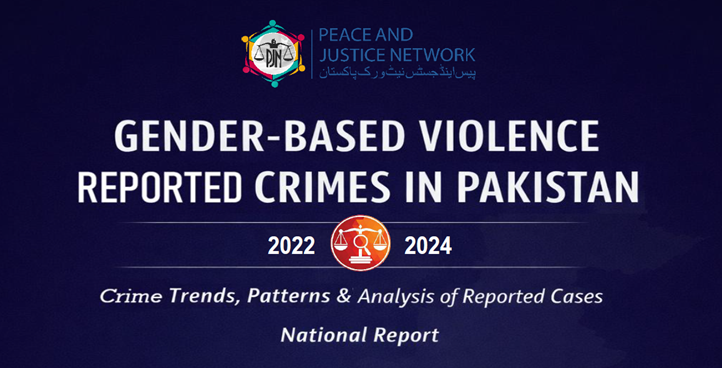
Launch of Pakistan National Report: Gender-Based Violence Crime Analysis 2022–2024 by PJN Pakistan
Tue, December 30, 2025
The National Gender-Based Violence (GBV) Crime Report 2022–2024, published by Peace & Justice Network (PJN) Pakistan under its Data for Justice Development (D4JD) Initiative, presents a comprehensive and evidence-based analysis of police-recorded gender-based violence across Pakistan. Covering a three-year period, the report documents the scale, patterns, and severity of violence experienced by women and girls and highlights urgent gaps in protection, accountability, and justice delivery.
Between 2022 and 2024, a total of 140,070 cases of violence against women and girls were reported to the police nationwide, revealing an alarming and sustained rise in reported GBV crimes. Year-on-year analysis shows a steady upward trend, with reported cases increasing by 18 percent in 2022, 22 percent in 2023, and a sharp 41 percent surge in 2024. While this increase reflects, in part, improved awareness and reporting in certain regions, it also signals escalating risks, persistent structural inequalities, and significant failures in prevention and protection mechanisms.
The findings show that kidnapping and abduction are the most prevalent forms of reported gender-based violence, accounting for 69,330 cases over the three-year period. This category alone represents nearly half of all reported GBV incidents, raising serious concerns about women’s and girls’ safety, freedom of movement, and vulnerability to exploitation. Domestic violence emerged as another major area of concern, with 11,590 cases recorded, including 3,419 cases resulting in death, highlighting the lethal consequences of violence occurring within homes and families.
The report also documents the continued prevalence of extreme and life-threatening forms of violence, including 1,160 honour killings and 364 cases of burning and acid attacks. These crimes reflect deeply entrenched patriarchal norms, harmful cultural practices, and the ongoing normalization of violence against women in many communities. Despite legal prohibitions, the persistence of these forms of violence underscores weak enforcement, limited deterrence, and social acceptance of impunity.


Sexual violence remains widespread and deeply underreported. Between 2022 and 2024, 14,736 cases of sexual violence were reported to the police, including rape, gang rape, custodial sexual violence, and incest. The data highlights the diverse contexts in which sexual abuse occurs—within families, communities, workplaces, and custodial settings—and points to systemic failures in prevention, survivor protection, and institutional accountability. The presence of incest and custodial sexual violence cases further underscores the heightened vulnerability of women and girls in situations of dependence and power imbalance.
Provincial and regional analysis reveals stark geographical disparities in reporting. Punjab accounts for more than 80 percent of all reported GBV cases, reflecting relatively stronger reporting mechanisms, greater access to police and justice institutions, and higher levels of awareness. In contrast, provinces and regions such as Balochistan, Khyber Pakhtunkhwa, Gilgit-Baltistan, and Azad Jammu & Kashmir report significantly lower numbers, which likely indicate severe underreporting rather than lower prevalence. Factors such as limited access to law enforcement, social stigma, fear of retaliation, informal dispute resolution practices, and weak institutional presence continue to suppress reporting in these areas.
A critical finding of the report is the disconnect between increased reporting and accountability outcomes. Despite the growing number of cases entering the criminal justice system, conviction rates in GBV cases remain below 3 percent. Weak investigations, inadequate forensic capacity, delayed medical examinations, poor evidence collection, and overburdened prosecution services consistently undermine cases. Survivors face prolonged trials, repeated adjournments, lack of witness protection, and intense social pressure, often leading to case withdrawal or hostile testimony. As a result, increased reporting has not translated into meaningful justice or deterrence.
The report also highlights gaps in data consistency and institutional coordination. Variations in policing structures—such as the division between police and Levies jurisdictions in Balochistan—and the use of alternative complaint mechanisms for workplace harassment in regions like Islamabad complicate efforts to develop a unified national picture of GBV. These gaps underscore the need for integrated, standardized, and survivor-centered data collection systems across all justice and protection institutions.
As the first national report consolidating police-recorded GBV crime data across all provinces and regions, this publication fills a critical information gap in Pakistan’s justice and human rights landscape. By making this data visible and accessible, the report aims to support evidence-based policymaking, strengthen institutional accountability, and inform targeted interventions for prevention, protection, and prosecution.
Ultimately, the findings of this report underscore that gender-based violence in Pakistan is not only widespread but also deeply systemic. Addressing it requires more than increased reporting—it demands comprehensive justice sector reforms, survivor-centered policing and prosecution, functional fast-track courts, strengthened protection services, and sustained political commitment. This report serves as a call to action for state institutions, civil society, and policymakers to move beyond acknowledgment and toward concrete, coordinated action to ensure safety, dignity, and justice for women and girls across Pakistan.


Copyright © 2026 pjn.org.pk